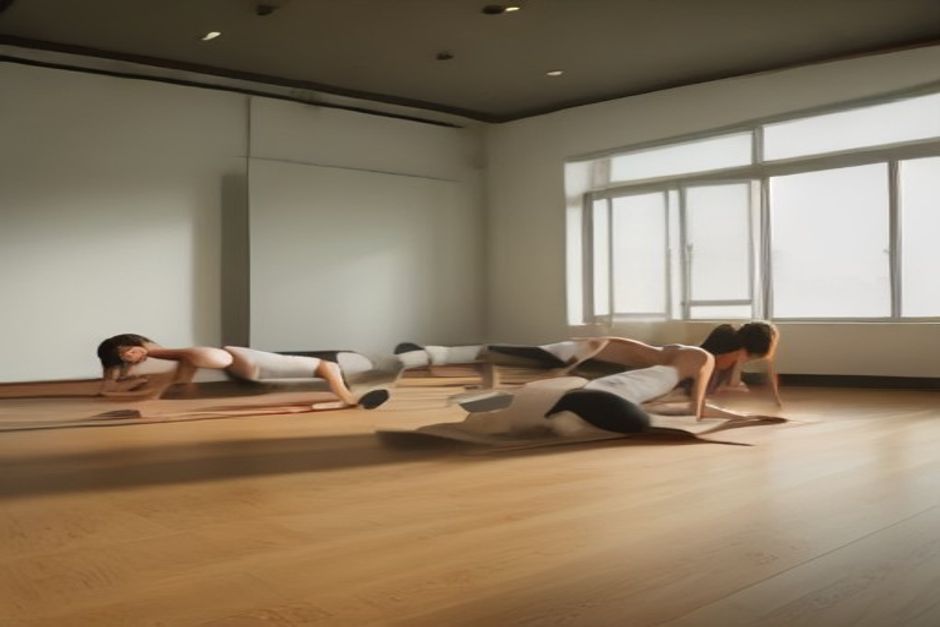
Power yoga is what happened when American fitness culture met Ashtanga and decided it liked the sweat but not the rules. The name was coined independently in the late 1980s and early 1990s by two Ashtanga students on opposite coasts — Beryl Bender Birch on the East Coast and Bryan Kest in Los Angeles — both of whom wanted a vigorous, breath-linked practice without the fixed series, the Sanskrit count, or the six-days-a-week discipline. The result is the hardest class on most gym schedules: a fast, flowing, strength-heavy practice where the teacher calls poses, the room is often heated, and nobody is chanting.
Where it came from
Both founders trained in Ashtanga Vinyasa, and it shows. Power yoga keeps Ashtanga's skeleton — sun salutations, standing poses, the chaturanga-to-upward-dog transitions, ujjayi breath — and throws away its script. In Ashtanga, the sequence is sacred and identical every day. In power yoga, the teacher improvises. One class might live in lunges and warrior variations; the next might be thirty chaturangas wearing different hats. Baron Baptiste later systematized his own branded version, and by the late 1990s "power yoga" had become the generic label for any athletic, fitness-forward flow class. It did for yoga what aerobics did for dance: made it legible to people who wanted exercise and were suspicious of incense.
What a class actually looks like
Expect 60 to 75 minutes of continuous movement, often in a room heated to 30–35°C, usually with music. A typical arc:
- Warm-up: sun salutations, sometimes with extra push-ups or core work folded in.
- Standing work: long holds in warriors, chair pose, lunges — the meat of the class, where legs burn and heart rates climb.
- Arm balances and core: crow attempts, plank variations, boat pose. Teachers here tend to offer "challenges" the way fitness instructors do.
- Cool-down: a brief stretch and a short savasana, which in a 4:30 pm gym slot may last 90 seconds before the next class needs the room.
The vocabulary is fitness vocabulary: reps, holds, "level up if you want." Alignment instruction varies wildly with the teacher's training, which is the style's biggest lottery. A power yoga teacher with a serious vinyasa background will keep you honest; one whose certification came with the gym membership may just keep you moving.
Who it honestly suits
Power yoga is a good fit if you already think of yourself as someone who works out, you get bored in slow classes, and you want yoga's mobility benefits wrapped in something that leaves you wrung out. It's also a reasonable gateway: many people who would never have walked into a traditional studio found their way to quieter practices through a power class at their gym.
It suits you less if you're brand new to movement and can't yet feel the difference between effort and strain, because the pace doesn't leave much room to learn. Fast transitions plus heat plus a competitive room is the recipe behind yoga's most common injuries: cranky wrists from repeated chaturangas, tweaked hamstrings from aggressive forward folds, shoulders dipped too low under load. The style rewards people who can self-regulate, and punishes people who treat every class like a test.
What gets gained, what gets lost
Gained: accessibility, intensity, and honesty about its goals. Power yoga doesn't pretend to be a spiritual practice; it's training, and it says so. Plenty of people get genuinely strong in these classes.
Lost: breath as the anchor rather than the background music, rest as part of the practice, and any systematic attention to the quieter limbs — the yamas and niyamas, concentration, meditation. You can always add those back yourself: a few minutes of pranayama before class or a short sit after closes the circle that the gym format leaves open.
Power yoga asked a fair question — what if yoga were honest exercise? — and answered it well. Just don't mistake the answer for the whole tradition.