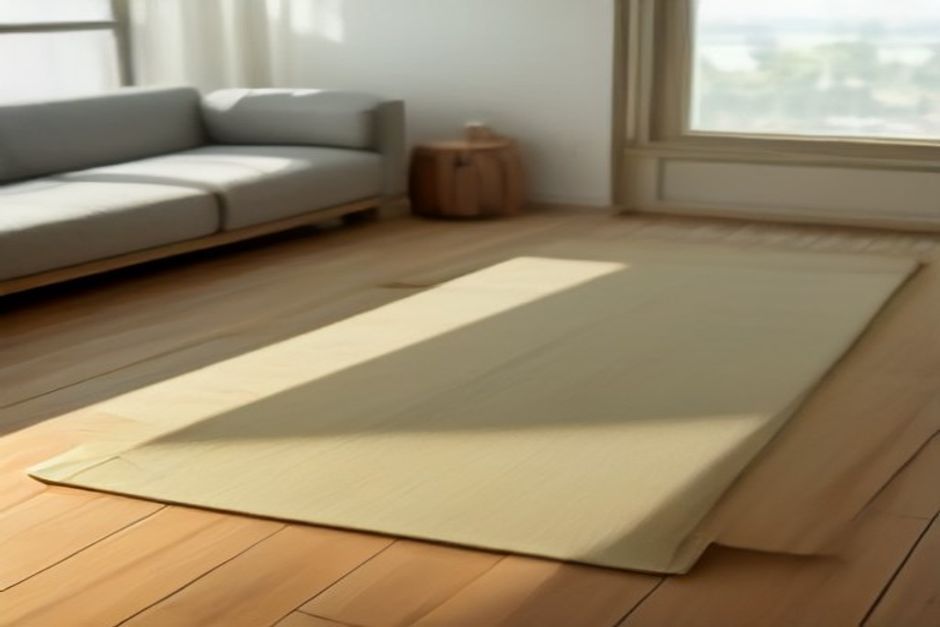
At some point in every practitioner's life, downward dog turns into a slow-motion slide. The hands creep forward, the feet creep back, and the pose becomes a negotiation with physics. The gear industry has an answer — actually two answers, which is where the confusion starts: do you need a better mat, a yoga towel, or both? The honest answer depends on one variable: how much you sweat.
What a mat actually does
A yoga mat's job is cushioning and grip on dry skin. The cushioning protects knees, hips, and wrists from the floor; the grip keeps hands and feet planted in standing poses. Most mats are made from PVC, TPE, natural rubber, or cork, and they perform best when your palms are dry. That is the catch almost nobody mentions in the product description: a standard mat's grip often gets worse when wet. Sweat pools on a closed-cell PVC surface and acts like a lubricant. This is why people who were perfectly stable in a gentle home practice start slipping the first time they try a warm, vigorous class.
Mat thickness and material matter — we break that down in mat thickness compared and the broader yoga mat guide — but no thickness fixes a slick, sweaty surface. That is a different problem, with a different tool.
What a yoga towel actually does
A yoga towel is a mat-sized piece of absorbent fabric — usually microfiber — designed to lie on top of a mat. Its logic is borrowed from beach towels and gym towels, with one upgrade: grip that improves with moisture. Microfiber gets tackier when damp, which is why hot yoga regulars sometimes spritz their towel with water before class even starts. Most yoga towels also have silicone or rubber nubs on the underside so the towel itself does not bunch and slide on the mat beneath it.
So the division of labor is clean:
- Mat: cushion, insulation from a hard or cold floor, dry-skin grip.
- Towel: sweat absorption, wet-skin grip, and a washable hygiene layer.
That last point deserves a sentence of its own. Studio rental mats are used by dozens of barefoot strangers between cleanings. A towel on top is a personal, machine-washable barrier between you and all of that history. Even people who never sweat much sometimes carry a towel to studios for this reason alone.
When a towel alone is enough
A yoga towel by itself — no mat underneath — works in a few specific situations. On carpet, where cushioning already exists, a towel adds just enough grip and cleanliness for a home practice. In a hotel room, where the alternative is a bare floor of unknown provenance, a travel towel beats nothing and packs down to almost nothing — see yoga while traveling for the rest of the on-the-road setup. And for restorative or yin practice, where you are lying on bolsters and barely moving, grip barely matters and a soft layer is genuinely pleasant.
Where a towel alone fails: any standing sequence on a hard floor. No cushion for the knees in lunges, no insulation, and the corners flip up during transitions. A towel is an accessory, not a floor.
When you genuinely need both
The combination earns its keep in exactly one environment: heat plus effort. Hot yoga is the obvious case — at 38 degrees and high humidity, everyone sweats, and a mat without a towel becomes a slip hazard by the second sun salutation. But vigorous vinyasa in a warm room, or just being a naturally heavy sweater in any style, produces the same physics. If your hands have ever slid in downward dog, you have met the problem the towel solves.
Two practical notes for the combo. First, get the towel with grip nubs on the underside — the flat kind migrates during class and you will spend half of savasana re-smoothing it. Second, some practitioners mist the towel lightly at the start of class; microfiber grips best slightly damp, not bone dry.
The buying order
If you are equipping yourself from zero, buy in this order:
- First, a decent mat. Mid-range, about 4–5 mm, a material with some texture. This covers 90 percent of practice situations.
- Then practice for a month. Notice whether you slip. Many people never do — gentle practice, dry palms, no problem to solve.
- Add a towel only when slipping actually happens, or when you start attending hot classes or using shared studio mats.
Skipping ahead — buying the towel, the spray, the mat bag, the alignment-marked deluxe mat — is how people end up with a closet of gear and a practice that never quite started. The honest cost of yoga is lower than the shops suggest.
Mat for cushion, towel for sweat, both for hot class, towel alone for travel and carpet. That is the whole decision. The sliding stops, the downward dog holds still, and you can go back to thinking about your breath instead of your hands.