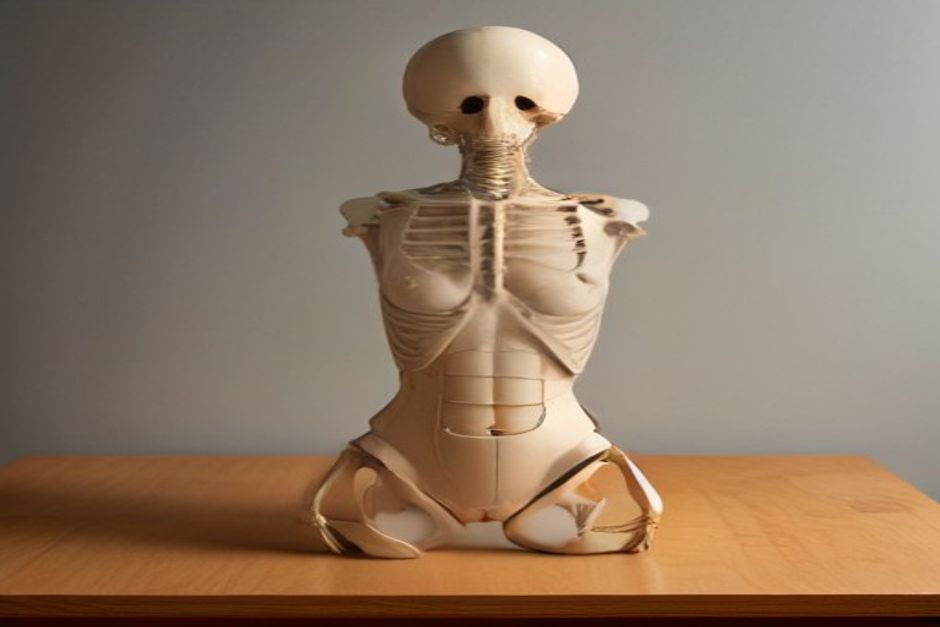
Somewhere between the last vertebra you can feel and the tailbone sits a triangular wedge of bone that quietly holds your entire upper body up. The sacrum — from the Latin os sacrum, "sacred bone," possibly because it was the part offered in ancient sacrifices, possibly because it's the last bone to decay — is five vertebrae fused into one solid plate. Everything above it (lumbar spine, ribs, skull, arms) transfers its weight through the sacrum into the pelvis and down the legs. It is, quite literally, the keystone: remove it from the arch and nothing stands.
The basic architecture
The sacrum sits wedged between the two halves of the pelvis (the ilia), forming the sacroiliac joints — the SI joints — on either side. Above, it meets the fifth lumbar vertebra at the lumbosacral junction, a common trouble spot because it's where the mobile lower back hands off to the nearly immobile pelvis. Below, it tapers into the coccyx, the tailbone.
Two features matter for practice:
- The SI joints move — but barely. A few millimeters of glide and a few degrees of tilt, mostly to absorb shock between spine and legs. They are stabilized by some of the strongest ligaments in the body. They are built for load transfer, not mobility.
- The sacrum tilts with the pelvis. When the pelvis tips forward, the sacral base tips forward and the lumbar curve deepens; when the pelvis tucks, the sacrum tilts back and the low back flattens. Every "tuck" or "untuck" cue you've ever heard is, at bottom, an instruction about sacral angle.
What SI aches usually mean
First, the disclaimer that actually matters: persistent one-sided low-back or buttock pain deserves a proper assessment by a doctor or physiotherapist. SI joint pain mimics disc problems and hip problems, and self-diagnosis from a yoga website is not a plan. That said, some patterns are common enough to be worth naming.
In twists: a sharp or nagging sensation on one side of the low back often shows up when the pelvis is pinned (seated, or in a deep lunge twist) and the twist is cranked from the spine alone. Because the SI joints barely move, forcing rotation across a fixed pelvis concentrates stress right there. The fix is unglamorous: twist less, let the pelvis participate a little, and keep both sides of the seat grounded rather than hiking one hip. A gentle reclined twist, where the floor limits how far you can go, is usually a friendlier option than a deep seated one.
In backbends: compression at the back of the waist — a pinch in upward dog or camel — often means the lumbar spine and sacrum are doing all the bending while the upper back contributes nothing and the hip flexors stay locked short. The sacrum gets squeezed between an arching lumbar spine above and a pelvis that won't tip. Lengthening the front of the hips first, and spreading the curve across the whole spine, usually changes the experience completely. See the lower back overview for the full picture of load-sharing.
In asymmetrical poses: one-legged poses, pigeon, lunges — anything where the two sides of the pelvis do different things — load the SI joints unevenly by design. That's normal and usually fine. It becomes a problem when you add force: pushing a knee down in pigeon, yanking into a revolved lunge. Uneven load is okay; uneven load plus leverage is how joints get annoyed.
Hypermobility, pregnancy, and the SI joint
Two groups deserve special mention. People with generally hypermobile joints often have SI ligaments with more give than average, and deep stretching — especially long-held yin-style hip openers — can irritate the joint rather than release it. Strength and stability work tends to help more than stretching; hypermobility in yoga covers this in depth.
During pregnancy, the hormone relaxin loosens ligaments across the pelvis to prepare for birth, and the SI joints become genuinely less stable. Wide stances, deep lunges, strong twists, and one-sided poses deserve extra caution in that season — smaller ranges, more support, and a prenatal-informed teacher if possible.
What actually helps
The research and the studio experience point the same direction: the SI joints like stability more than stretch. Useful habits:
- Strengthen the neighborhood. Glutes, deep core, and the muscles of the inner thighs all brace the pelvis. Bridge pose and side-lying leg work are quietly excellent here. See why glutes matter.
- Twist with a moving pelvis. Let the twist be smaller and the breath be bigger.
- Symmetry after asymmetry. After pigeon or lunges on one side, do the other side, then something symmetrical — a fold or a brief squat — to let the pelvis settle evenly.
- Respect the one-sided ache. Pain that lives on one side of the sacrum, that worsens with the same pose every time, is information. Modify the pose, and if it persists, get it looked at.
The sacrum asks for very little: distribute bends across the whole spine, don't force rotation across a pinned pelvis, and keep the muscles around it strong enough to do their job. In return it carries your spine around all day without complaint. A fair deal. For the bigger map, see the spine overview and the dedicated page on the SI joint itself.