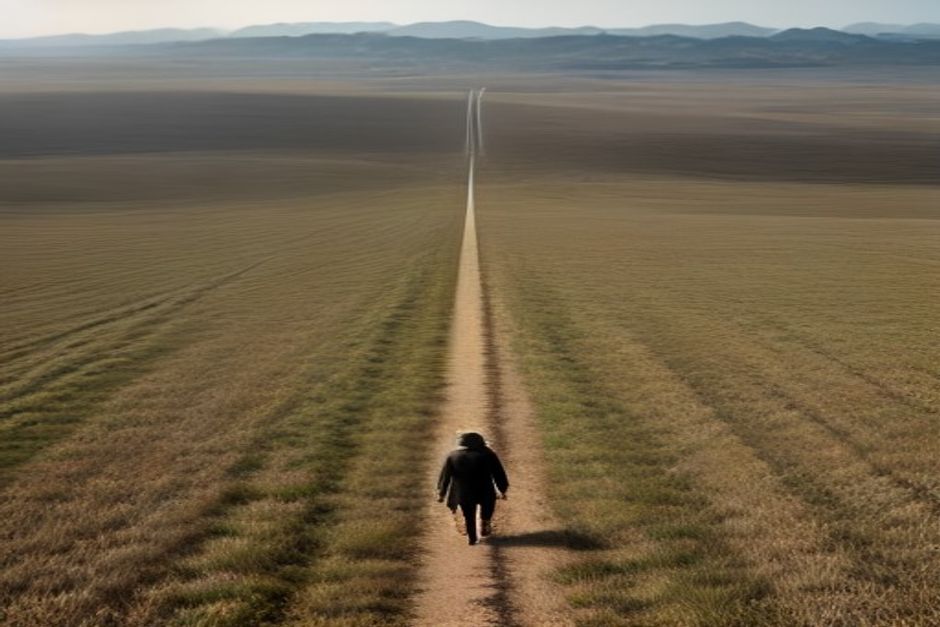
Every long-running practice passes through the same weather pattern. The first months bring visible progress almost weekly — the forward fold deepens, balance steadies, poses that were impossible become possible. Then, somewhere around month four or five, the graph flattens. The fold stops deepening. The wobble in Warrior III is the same wobble it was in June. Practice still happens, but it has gone from exciting to maintenance, and a quiet question arrives: is this still working? The short answer is yes. The longer answer is worth understanding, because the plateau is where most people either quit or make exactly the wrong changes.
Why the plateau exists
Beginner progress is mostly skill learning, and skill learning is fast. In the first months your nervous system is figuring out basic coordination: how to find your balance point, where your limbs are in space, how to breathe while bent in half. These gains show up as dramatic, visible improvement, and they are real — but they are learning, not transformation. Once the basics are learned, progress shifts to slower materials: tendons, joint capsules, and tissues that adapt over months and years, not weeks. The plateau is often just the moment you run out of easy neurological gains and meet the actual speed of your connective tissue, which as the truth about flexibility explains, was never going to move quickly.
There is a second, less flattering cause: practice becomes automatic. The sequence you once had to concentrate through is now done on autopilot, and autopilot practice maintains but does not build. The body adapts to demands; a demand it has fully adapted to stops producing change. This is not a failure of effort. It is arithmetic.
Plateau or burnout? Diagnose first
Before changing anything, tell two conditions apart, because their treatments are opposite. A plateau feels flat but neutral: you practice, nothing much happens, nothing much hurts, and the idea of practicing tomorrow is fine. Burnout feels flat and resistant: the mat repels you, small poses feel heavy, sleep and mood are off, and the idea of practicing tomorrow produces a small internal groan. A plateau calls for a stimulus change. Burnout calls for rest — genuinely less practice for a week or two, more sleep, and maybe a look at whether practice has quietly become one more item on an overloaded list. Treating burnout with more intensity is how a flat month becomes a lost year.
What to change (a little)
- Change the variable you never touch. If you always flow, hold poses for two minutes. If you always hold, move. If you always practice alone, take a class; if always in class, practice alone. The body notices novelty more than volume.
- Add one honest challenge. Not a new practice — one pose or skill at the edge of your ability, visited briefly and often. Arm balances like Crow are famous plateau-breakers precisely because they demand the nervous system learn again.
- Measure something different. If flexibility stalled, watch balance. If balance stalled, watch breath. Practitioners who track only one dimension experience more plateaus than actually exist.
- Let a teacher see you. A single class with a teacher who watches and corrects can reveal the habit — the dumped hip, the locked knee, the held breath — that has been capping progress invisibly for months. A structured course does this over weeks rather than minutes.
What to leave alone (mostly everything)
The wrong response to a plateau is renovation: new style, new teacher, new hour-long commitment, new gear, all at once. This usually produces a month of novelty followed by the same flatness, now with more guilt. The plateau is not evidence that your practice is wrong; it is evidence that your practice has become familiar, which is what practice is supposed to do. Keep the schedule. Keep the core sequence. The tradition even has vocabulary for this — abhyasa and vairagya, practice and non-attachment, the pair Patanjali says must run together. The plateau is where non-attachment stops being a concept and becomes a skill: can you practice without the reward of visible progress? The people who can are the ones still practicing in ten years.
The plateau's actual job
Consider what the plateau asks of you, because it is the same thing meditation asks: sit with an experience that is not producing fireworks, and stay anyway. A practice that only survives excitement is a practice with an expiration date. The flat months strip away the feedback and leave the question that was always underneath: do you practice for what it produces, or for what it is? Most honest practitioners find the answer is some of each, and that is fine — but the plateau is where the ratio gets tested. On the other side of it, progress resumes, because it always does; the graph of a years-long practice looks like a staircase, not a ramp. If you are on a step, you are not stuck. You are just on a step. Keep going, the way you learned to keep going through ordinary days and ordinary weeks — the next rise is already under your feet.