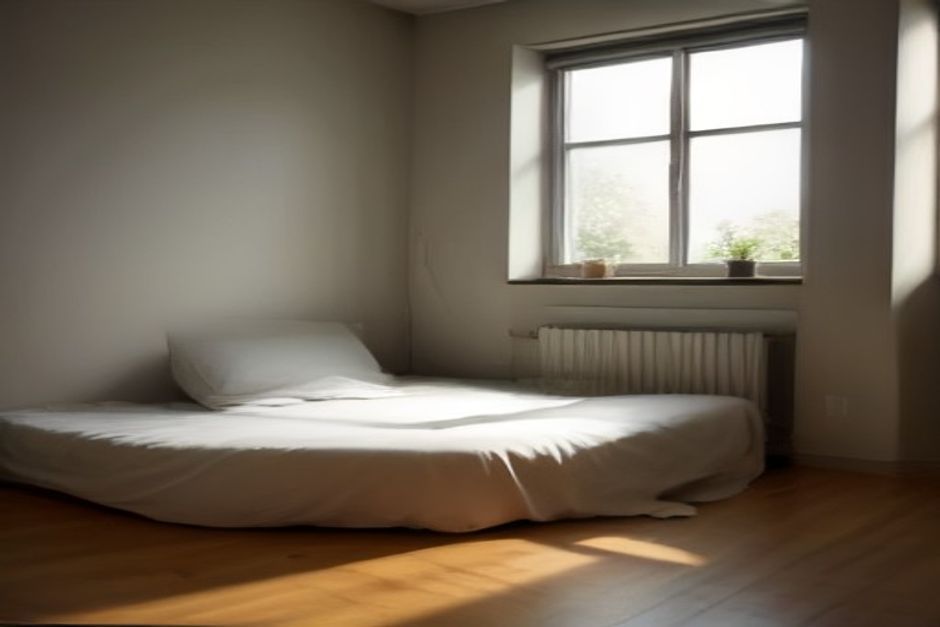
A yoga mat is about two meters long and a bit over half a meter wide. That is roughly the floor space next to a hotel bed, the clear patch in a studio apartment, or the strip between the desk and the bookshelf in a home office. It is also — and this is the point of this page — enough. Not "enough if you lower your standards." Enough, full stop. A large fraction of what yoga actually does for a body happens within the mat's borders, and the belief that practice needs a big, quiet, beautiful room has ended more home practices than tight hamstrings ever did.
What fits in a mat's footprint
More than you think. The entire floor family fits by definition: seated folds, twists, hip openers, core work, and everything on your back. Cat-Cow and all the hands-and-knees work fits. Child's Pose fits. Low lunges fit if you angle the mat. Standing poses mostly fit with one adjustment: step your feet to the mat's long edges for wide stances instead of spreading sideways into the furniture. Sun salutations fit — the forward and backward travel of a salutation is exactly one mat long, which is not a coincidence.
What does not fit: walking flows, cartwheel-adjacent experiments, and anything involving a running start. Also, jumping transitions, for two reasons: the space, and the downstairs neighbors, who did not consent to be part of your practice. Step your transitions instead of jumping them. Slower, quieter, and — inconveniently for your excuses — better strength training anyway.
Furniture is a prop collection you already own
Small spaces come with built-in equipment. A wall gives you balance support for standing poses, a place for Legs Up the Wall, and feedback in poses like Warrior III where you can reach back and check whether you are actually near it. A sturdy chair is a yoga prop wearing a disguise: seated twists, supported backbends over the backrest, elevated hands for forward folds, and an anchor for standing quad stretches. The edge of a bed does the same job at a different height. Our household props page covers the full conversion chart from "stuff in your apartment" to "yoga equipment," and none of it requires a trip to a store.
In genuinely tight quarters, orient the mat diagonally. It looks eccentric and buys you surprising amounts of usable length for lunges and split-leg work. Practice is allowed to look eccentric. Nobody is grading the geometry.
The quiet practice for shared walls
Small spaces are usually acoustically shared spaces. The considerate — and, again, secretly superior — version of practice avoids impact: no jumping back to plank, no dramatic flopping to the floor, blocks and the bolster placed rather than dropped. Slow sun salutations at walking pace, standing poses held while breathing quietly, long floor work — this is a complete practice that your downstairs neighbor will never know happened. If the situation allows it, a rug under the mat softens both sound and knees. Standing meditation and breathwork, it should be noted, are completely silent and take zero floor space; on the most cramped days they are the whole session.
The mental shift that makes it work
The real obstacle in a small space is rarely square meters. It is the picture in your head of what practice is supposed to look like — the airy studio, the full expression, the wide-armed everything — measured against your mat between the bed and the wall, found wanting. That comparison is worth retiring. The studio versus home trade-offs cut both ways, and one thing a cramped home practice teaches faster than any studio can is adaptation: you learn which parts of a pose are essential and which are decoration, because the wall will inform you immediately. Practitioners who learned in small spaces tend to have tidy, efficient, neighbor-friendly movement. The constraint trains you.
A practical starter session for a two-meter world: two minutes seated breathing, five rounds of slow Cat-Cow, a low lunge each side with the back knee down, three standing poses with a hand near the wall, a seated twist, and two minutes of stillness. Fifteen minutes, one mat, zero collisions. Repeat most days, and you have a practice that no lease, layover, or living situation can take away from you.
The big room is nice. The small room is enough. The mat, it turns out, was always the whole studio.