Teenagers have excellent radar for being talked down to, and most "yoga for teens" content sets it off within a paragraph. So here is the honest version. Yoga will not make you enlightened, fix your grades, or turn you into the kind of person who wakes up at five a.m. smiling. What it can do — with decent evidence and a lot of ordinary experience behind it — is help with three specific problems that dominate teenage life: stress that spikes around exams, a body stiffened by hours of screens, and a brain that refuses to power down at night. If you practice with your kids, our kids' yoga piece covers the younger crowd; this one is for the roughly-thirteen-and-up set, who need a different pitch entirely.
What actually appeals to teenagers
Not Sanskrit. Not chanting. Not being told to "just breathe" by an adult who clearly has no idea what a group chat can do to a Tuesday. What works is framing yoga the way athletes frame it: as maintenance for the equipment. Every teen understands that a phone needs charging and a phone with a cracked screen needs a case. Bodies are the same — they need input, and they break in predictable ways when they don't get it. The poses are physical training with immediate, feelable results: tight hips loosen, a clenched jaw unclenches, a racing heart slows down on purpose. That last one is close to a superpower during exam season, and it's teachable in about ten minutes.
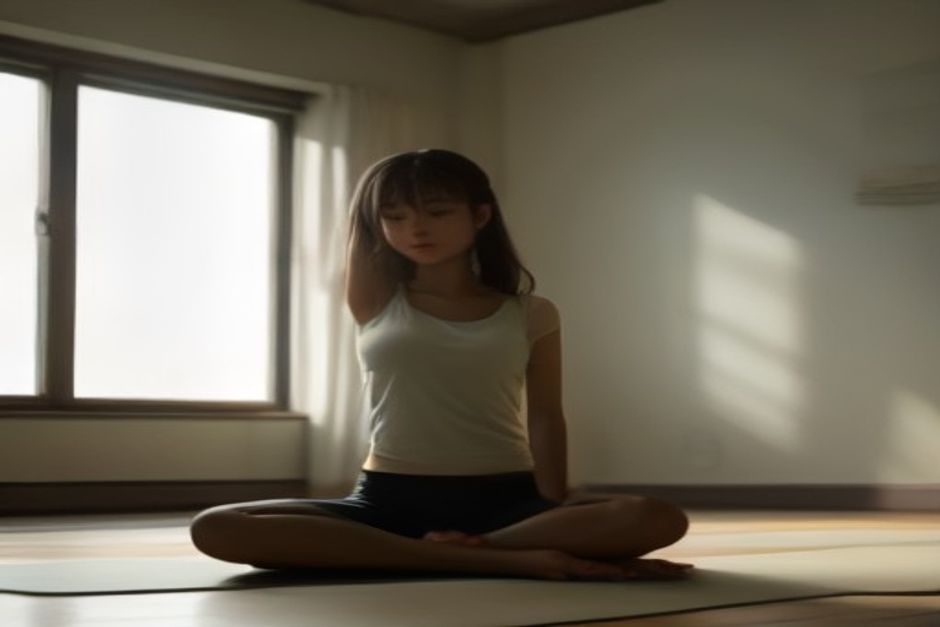
The other thing that works: privacy. A teenager is far more likely to practice alone in their room with the door shut than in a class where they might be seen trying. Honor that. A mat, a floor, and a closed door is a complete yoga studio. Our ten-minute practice framework fits this perfectly — short enough that it doesn't feel like homework, structured enough that it doesn't feel like nothing.
For exam stress: the pre-study reset
Stress before an exam isn't weakness; it's physiology. The nervous system can't tell the difference between a predator and a pop quiz, and it prepares for both the same way — shallow breathing, tight shoulders, tunnel vision. The fix is mechanical. Two minutes of slow breathing with a longer exhale than inhale tells the nervous system the threat has passed, and the body believes it before the brain does. Follow that with a minute of cat-cow to unglue the spine from the desk-chair shape, and thirty seconds of standing forward fold with bent knees to get blood moving somewhere other than the anxiety loop. Four minutes, total. Do it before opening the textbook, not after the panic sets in.
For screen bodies: the daily unkinking
Hours of phone and laptop time produce a specific posture: head forward, shoulders rounded, hips locked at ninety degrees. This isn't a character flaw, it's geometry, and geometry can be reversed. Three poses cover most of the damage. Child's pose with arms stretched forward opens the upper back. A gentle cobra or sphinx pose undoes the rounded shoulders — the chest-opening cousins of these live in our pose library. A low lunge, one minute per side, gives the hip flexors back their original length. Ten minutes a day of this beats an occasional heroic hour, the same way brushing your teeth beats an annual deep clean.
For sleep: the last fifteen minutes
Teen sleep is a genuine problem — school starts early, biology wants late nights, and phones fill the gap. Yoga's contribution is a shutdown ritual: the same short sequence every night, done in low light, signals to the brain that the day is over. Legs up the wall for five minutes, a slow reclining twist on each side, then a few minutes lying flat with attention on the breath. Our sleep and yoga page has the full routine. The crucial part isn't the poses — it's the repetition. A ritual works because it's boring, and boring is exactly what an overstimulated brain needs at midnight.
Ground rules for families
If you're a parent reading this: don't make it a lesson. The fastest way to kill a teenager's interest in yoga is to correct their form or turn it into a family wellness initiative. Offer the mat, share a link, mention that athletes use this stuff, and then leave the room. If they ask questions, answer them; if they don't, consider the eye-roll a maybe. And if anxiety around exams or anything else ever moves past everyday stress into something heavier — poor sleep for weeks, loss of appetite, withdrawal — that's beyond yoga's job description, and our piece on yoga and anxiety is clear about where practice ends and professional support begins. Yoga is maintenance, not medicine. For a teenager, that framing isn't a limitation. It's the whole selling point: no promises, no pressure, just a body that works a little better tomorrow than it did today.