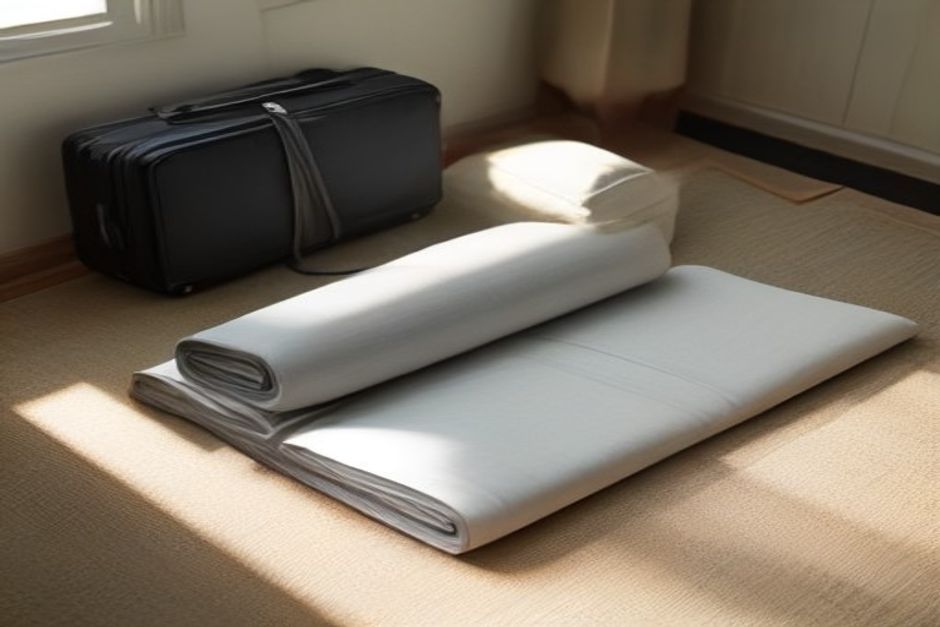
Every trip begins with the same quiet argument at the suitcase: the travel mat is one to two kilograms and half the length of the bag, and it will either be the thing you are gladdest you packed or the thing you carried four thousand kilometers to lean against a hotel wall. Here is how to settle the argument before you zip up.
What a travel mat actually is
A travel mat is not a small mat; it is a thin one — usually one to two millimeters of rubber that folds like a T-shirt or rolls to the diameter of a newspaper. It weighs little, grips well, and cushions almost nothing. That last point is the trade at the heart of the whole category: you are carrying grip, not comfort. On a hard hotel floor your knees will know the floor is hard. On carpet, thin rubber is genuinely pleasant. Our mat guide covers materials in general, and the mat-versus-towel comparison covers the other half of this decision.
The case for packing it — and the case for the towel
Pack the mat if you practice most days and know you will on the road; if you are staying somewhere with hard floors; if your practice includes anything where slipping hands end the pose — downward dog on a sliding towel is a core workout you did not ask for; or if the trip is long enough that the mat doubles as your whole exercise space. Skip it if the trip is under a week and your practice can bend, if the hotel has carpet, or if your itinerary is museums and meals rather than mornings on the mat. Be honest here, because the aspirational mat is the heaviest thing in travel. The hotel-towel workaround — a bath towel over carpet for seated and supine work, bare feet on a dry floor for standing — covers a surprising amount of a gentle practice. We have done whole trips on towels and small-space sequences, and the practice survived fine.
Hotel room practice
The hotel room is a specific dojo: a bed you must not fall onto, a minibar in the kick zone, and downstairs neighbors of unknown patience. A few field notes. Move the desk chair before you start, not with your foot mid-warrior. Keep jumps and anything with impact out of it — this is not the trip for jump-backs; slow step-throughs are silent, and your practice loses nothing. Morning is safer than evening for noise. A folded bath towel under the knees supplies the cushioning the travel mat does not. Ten quiet minutes before breakfast changes the texture of an entire travel day.
Airports and airplanes
The airport is where yogic discretion earns its keep. Nobody needs to see your sun salutations at gate B14, and the security queue is not the place. What works without an audience: standing hip circles and calf raises in the queue, a seated figure-four stretch in the waiting chairs, neck half-circles anywhere. On the plane itself, the practice shrinks to the seat: ankle circles, seated cat-cow on long hauls, shoulder rolls, and slow breathing — which, unlike everything else in economy class, is free and unlimited. Walk the aisle when the seatbelt sign allows; that is not yoga, just circulation, and it matters more.
Arriving: jet lag's soft landing
The best travel practice is the one at the far end. After a long flight the body is a specific kind of wrecked — hips shortened by the seat, ankles puffy, spine compressed, clock confused. If it is daytime at your destination, resist the nap and do twenty minutes of the gentlest possible movement instead: cat-cow, a low lunge each side, a supine twist, then legs up the wall for the feet that swelled at altitude. Our post-flight routine has the full version. Then daylight, a walk, and dinner at local time. The mat, if you brought it, has now paid for its ticket.
The real answer to the travel mat question, like most packing questions, is knowing which traveler you actually are — not the one you pack for. Pack for the honest one.