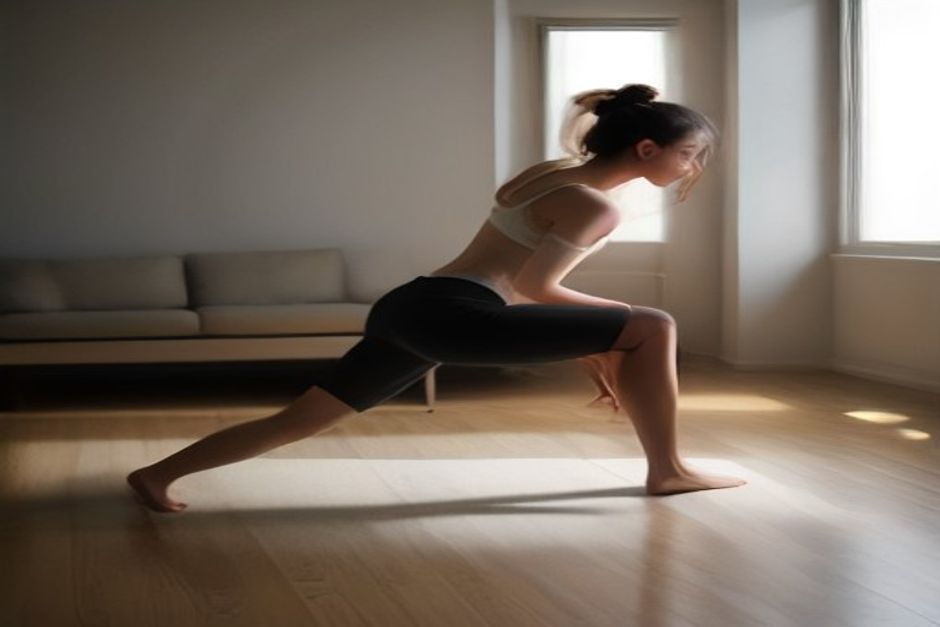
Search for home yoga inspiration and you'll find sun-drenched lofts with twelve-foot ceilings and nobody downstairs. Then you look around your own place: a mat-sized gap between the bed and the wall, a coffee table with exactly one place it can go, and neighbors who can hear a dropped spoon. Good news, honestly delivered: this is enough. A complete, serious yoga practice fits inside six feet by two. It just looks different from the studio version, and pretending otherwise is where most small-space practice dies.
The space audit
Before adapting the practice, get honest about the space. Roll out your mat in the clearest spot you have. Now check four things: can you lie flat with arms overhead? Can you reach both arms straight out to the sides? Can you step one foot forward from the mat's back edge without kicking anything? Is there a wall or door within reach? If you answered yes to the first two, you have everything yoga actually requires. The forward step and the wall are bonuses that open up lunges, handstand-free inversions, and balance work with a safety rail.
One setup habit makes the whole thing sustainable: reduce the friction of starting. If the mat lives in a closet under three boxes, you will not practice. Lean it against the wall behind the door, or leave it rolled out permanently in its gap — in a small apartment, a permanently unrolled mat is not clutter, it's furniture with a purpose.
Practicing quietly (the downstairs problem)
The real constraint of apartment yoga isn't space — it's sound. Jump-backs, hopping to the top of the mat, and thudding out of balances are what your downstairs neighbor experiences of your practice. The fixes are simple and, as a side effect, they make you stronger:
- Step, don't jump. Stepping from downward dog to a lunge — slowly, with control — is harder than jumping and builds exactly the core strength the jump was faking. Call it an upgrade, not a compromise.
- Lower like you mean it. The loudest moment in most flows is chaturanga done carelessly — knees and chest flopping down. Slow lowering is silent lowering.
- Skip the bouncy stuff entirely. Burpee-flavored vinyasa was never mandatory. A slow flow is a quiet flow.
- Two mats, or a rug under the mat. Doubling up dampens both sound and the hardness of floors, and your knees will vote for it too.
What to practice in six feet
Some poses are space-hungry — wide stances with sweeping arms, sprawling supine twists with legs flung across the room. Most of the canon is not. A small-space rotation could look like this:
- Warm-up: cat-cow, thread-the-needle, gentle lunges with hands on the front thigh — everything within the mat's rectangle.
- Standing work: mountain, chair pose, warrior I and II with a slightly shortened stance, tree, eagle. All of these live happily on one mat; just point the long axis of the stance along the mat, not across the room.
- Floor work: boat, bridge, happy baby, reclined twists with knees bent and feet wide instead of legs straight — the compact version loses nothing.
- Rest: child's pose and savasana. If the mat-gap is tight, do savasana on the bed; a soft surface is a legitimate variation, not a failure.
The one genuine loss in a small space is big, traveling movement — the feeling of covering ground. If you miss it, take it outside: a park, a rooftop, even a quiet corridor. Keep the apartment practice for everything stationary, which is most of yoga.
Furniture is free props
Studios charge membership partly for their prop closets. You already own equivalents. A chair is a yoga chair: seat for supported backbends, backrest for balance in standing poses, edge for a deep supported forward fold. The wall is the best prop ever made — legs-up-the-wall, standing balances with a fingertip of security, half-handstands for the brave. A firm couch cushion is a bolster; a rolled bath towel is a blanket roll; a belt is a strap. Our guide to household props covers the substitutions in detail.
The mental reframe
Small-space practice fails more often in the head than in the room. The loop goes: this doesn't count, it's cramped, it isn't real yoga, I'll do a proper session later. Later never comes. The counter is simple: the poses don't know how big your room is. Twenty minutes of attentive movement in a gap beside the bed does more for your hips and your head than the imaginary studio session you keep postponing. A ten-minute practice done daily in a small apartment beats a perfect practice done never.