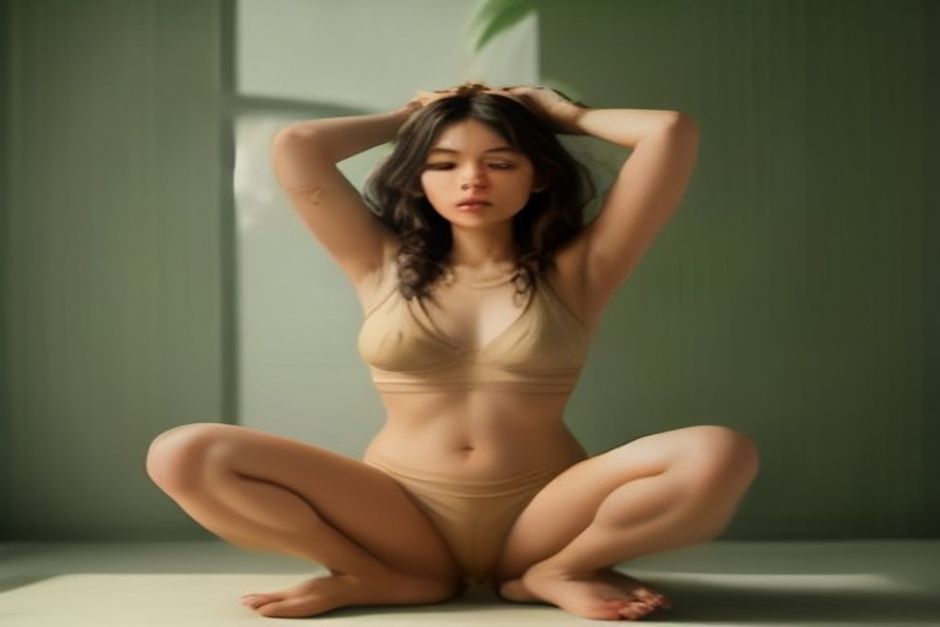
Malasana — usually translated as Garland Pose, though mala also means the garland of prayer beads — is the deep resting squat: feet flat, hips low, knees wide, hands pressed together at the chest. Children do it perfectly and adults in much of the world still rest, cook, and chat in it. Adults in chair-shaped countries often can't get within a foot of the floor without tipping backward. That's not a character flaw; it's what decades of sitting do to ankles and hips. The good news: the squat is a trainable position, and Malasana is the training ground.
Step by step
Garland Pose — Malasana
How: Stand with feet about hip-width apart, toes turned out comfortably — 15 to 30 degrees. Bend the knees and lower the hips toward the floor, letting the knees travel wide, in the same direction the toes point. Bring the palms together at the chest and nestle the upper arms or elbows against the inner knees, using gentle pressure both ways: knees pressing in, arms pressing out. Lift the chest, lengthen the spine, and breathe. Stay for 5–10 breaths, then place the hands down and rise slowly.
Why: The deep squat opens the hips and inner thighs, restores ankle and calf range of motion that chairs steal, gently decompresses the lower back, and — as a bonus — the upright torso against wide knees quietly trains posture muscles.
The three things that go wrong
1. The heels lift. The most common issue, and the most fixable. Tight calves and stiff ankles won't let the knees travel far enough forward, so the heels pop up and the whole pose becomes a tiptoe balancing act. The fix: roll your mat (or a folded blanket) under the heels and keep them supported. This is not cheating; it's calibration. Over weeks, unroll the support a little at a time. Pressing down through the big-toe mound also helps the arch stay alive instead of collapsing.
2. You tip backward. A balance problem before it's a flexibility one: in the deep position your center of mass sits behind your base of support. The counterbalance trick: reach the arms straight forward at shoulder height as you descend — the weight of the arms pulls the torso forward and lets the hips drop. Once stable, bring the hands to the chest. If even that fails, hold the edge of a doorframe, a heavy table, or a partner's hands while you sink. Borrowing balance while building the position is standard practice, not a shortcut.
3. The knees drift inward. In the deep squat, knees should track over the toes — wide, not pinched together. Letting them collapse inward loads the joint sideways. Use the arm-pressure cue: elbows actively pressing the knees open, knees actively resisting. That dialogue of pressure is also what makes Malasana more than a passive hang — it's the difference between stretching the hips and actually using them. More on this on the hip anatomy page.
Useful variations
- Supported squat: sit on a yoga block or a low stack of folded blankets, elbows still pressing the knees wide. You get the hip opening without the balance demand — the right choice while building the position or on tired days.
- Malasana twist: from the full pose, reach one arm down to the floor and the other up, rotating the chest open. Five breaths each side. Lovely for the mid-back after desk work.
- The daily hang: skip the formal pose entirely and just spend two minutes a day in a supported deep squat — reading, waiting for the kettle. Accumulated minutes restore the position faster than weekly heroics.
Why it's worth reclaiming
There's no need to romanticize the squat as ancient wisdom — it's simply a resting position human hips were built around, and one that keeps several joints moving through ranges that office life never visits. Regular squatting maintains ankle dorsiflexion (you'll notice it in Downward Dog), keeps hip flexion honest (you'll notice it getting out of chairs at seventy), and provides a genuinely restful shape for the lower back once the position is familiar. It's also the gateway to arm balances like Crow, which is essentially Malasana with ambition.
Who should be careful
Knee injuries or recent knee surgery: deep flexion loads the joint — practice only the supported version, or skip it, until cleared by a professional; knee pain in the pose is a stop sign. Hip replacements: deep flexion plus rotation can violate post-surgical precautions — ask your surgeon or physiotherapist first. Pregnancy: often wonderfully comfortable with wide knees making room, but use support for balance. If you feel dizzy on rising (blood pressure shifts), come up in stages and pause halfway. Browse the pose library for gentler hip openers like Bound Angle if the squat isn't for you right now.
The honest summary: Malasana is less a pose to achieve than a position to move back into. Support the heels, borrow balance, show up for two minutes a day, and the floor gets closer on its own schedule. Your ancestors squatted for millennia without a single yoga class — you're just reminding the hips of the family trade.