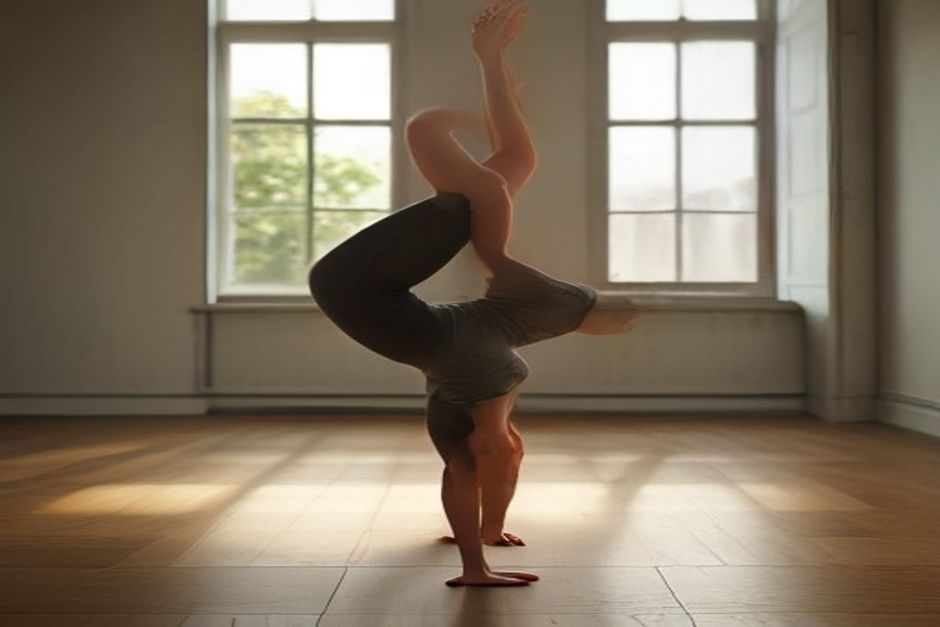
If low lunge is where tight hip flexors go to negotiate, lizard pose — Utthan Pristhasana — is where the negotiation gets serious. The front foot steps wider, the hands (or forearms) come to the inside of it, and suddenly the outer hip of the front leg and the inner thigh of the back leg are both involved in a conversation you'd been avoiding. It is one of the most effective hip openers in the standing-adjacent family, and one of the easiest to do badly by muscling through.
The name translates roughly as "stretched-out lizard pose," which is as unglamorous as it sounds. Good. This is a working pose, not a photo pose.
Setting up the base
Lizard, hands down — Utthan Pristhasana
How: From a low lunge with the right foot forward, walk the right foot to the right edge of the mat and turn the toes out slightly — ten or fifteen degrees, not forty-five. Bring both hands to the floor inside the front foot. Keep the back knee down with the top of the foot on the mat for the kinder version, or lift the back knee and press through the heel for more intensity. Let the hips sink toward the floor without collapsing the chest; think "long spine, heavy hips."
Why: With the front foot wide and turned out, the stretch moves from the front of the hip into the outer hip and glute — the territory that pigeon reaches from a different angle. Together they cover most of what sitting all day locks down. There's more on why this area gets so cranky on the hip anatomy page.
Making it accessible
Lizard on blocks
How: Same setup, but place a block under each hand at whatever height keeps your spine long. Over weeks, move the blocks to lower heights, then to the floor, then — maybe, eventually — forearms. There is no schedule for this. Tight hips operate on geological time.
Why: Rounding the spine to reach the floor trades hip opening for back strain, which is a bad swap. Blocks keep the work in the hips where it belongs. (This is the entire argument for owning props, made again in the props guide.)
Forearm lizard
How: From the hands-down version, lower the forearms to the floor or to a bolster inside the front foot. Let the head hang. Stay for five to ten slow breaths — this version borders on yin territory, and time does more than effort here.
Why: Forearms down deepens the load on the front hip while removing the arm work, so you can actually relax into the stretch instead of holding yourself up through it.
The outer-hip option
From any version, gently press the front knee away from you with the hand on that side — a slow, steady pressure, not a shove — and let the foot roll onto its outer edge if that's comfortable for the knee. This shifts the stretch further into the outer hip and glute. It should feel like strong, dull stretch, never sharp, and never in the knee joint itself. If the knee complains, bring the foot flat again and back the knee in.
Common mistakes
- Collapsing into the shoulders. If your ears are hiding behind your upper arms, come up onto blocks. A long spine beats a low chest every time.
- Forcing the hips down. Bouncing or pushing into end range wakes up exactly the protective tension you're trying to melt. Sink on exhales; pause on inhales.
- Ignoring the back leg. Even with the back knee down, keep a little tone there — press the top of the foot into the mat. A limp back leg lets the pelvis dump forward and turns a hip stretch into a low-back pinch.
- Skipping the second side. One hip is always tighter. Do the tighter side second, when you're warm, and give it a few extra breaths.
Lizard fits naturally after sun salutations or any standing sequence, once the legs are warm — cold hips and deep lizard are a poor pairing. It also makes a strong second act after low lunge and before pigeon in a hip-focused practice.