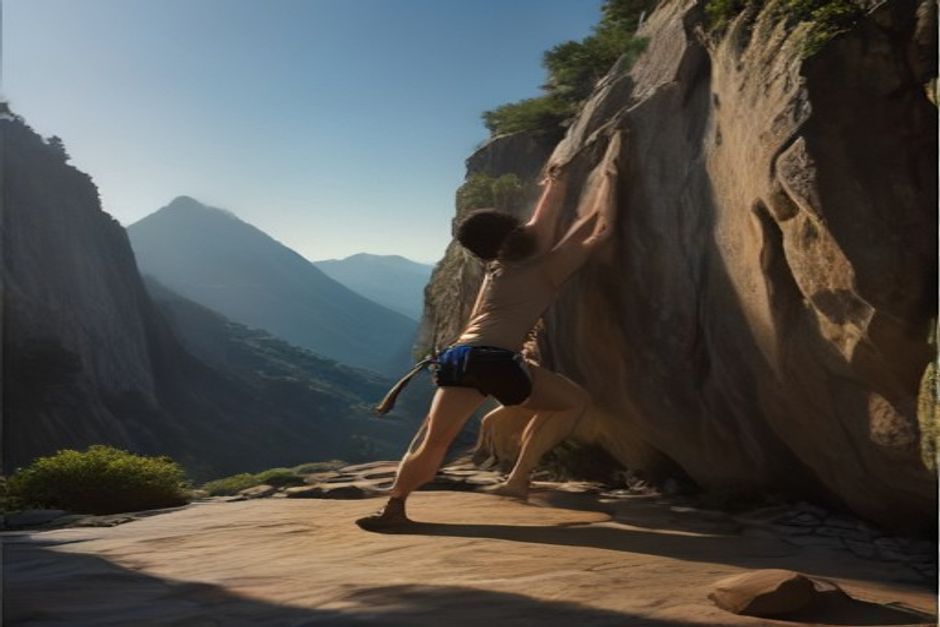
Climbing is one of the most complete sports around — strength, technique, nerve, problem-solving. It is also gloriously one-sided in its demands. You pull, you grip, you lift your knees to your chest, and you do it for hours. The result, over seasons, is a predictable pattern: forearms like cables, fingers that creak, shoulders rolled forward, hips that high-step brilliantly and do very little else. Yoga's role for climbers is not to make you better at pulling. It is to train everything pulling leaves out.
Fingers and forearms: the maintenance nobody does
Every hold is a grip, and every grip loads the finger flexors and the forearm muscles that drive them. The extensors — the muscles on the back of the forearm that open the hand — do essentially nothing while climbing. That imbalance is behind much of the elbow and forearm grumbling climbers accept as normal.
The counter-practice is unglamorous and takes three minutes:
- Wrist extension stretch: palm down on the mat or a table, fingers pointing back toward you, gentle lean until you feel the top of the forearm. Thirty seconds a side.
- Finger extension work: a rubber band around the fingertips, opened against resistance, fifteen slow reps. Boring. Works.
- Wrist circles and gentle fist-to-open flows before climbing, not just after — warm tissue complains less.
One honest note: yoga itself loads the wrists heavily — planks, downward dog, arm balances. If your wrists and elbows are already grumpy from the wall, a yoga session full of vinyasas is not recovery, it is a second shift. Choose floor-based and forearm-based variations, and read wrist care for yoga before assuming more mat time is the answer.
Shoulders: open what pulling closes
Climbing is lat-dominant and chest-forward. The shoulder spends its climbing life in internal rotation and elevation — reaching up, pulling down. The yoga antidote is the opposite territory: external rotation, horizontal opening, and scapular stability in positions other than hanging.
The short list that earns its time:
- Thread the needle — thoracic rotation plus a gentle posterior-shoulder stretch, the two things a pulling sport uses up.
- Clasped-hands chest opener behind the back, standing or kneeling — undoes the forward roll without any equipment.
- Cow face arms with a strap — the internal/external rotation pairing most climbers can barely enter at first, which is diagnostic, not shameful.
- Wall slides and prone Y-raises — the lower traps and rotator cuff stabilize the shoulder blade; strong pulls on an unstable blade is where impingements come from.
Hips: more than the high step
Climbers develop excellent hip flexion — knees to chest, high steps, frog positions on overhangs. What goes undertrained is the opposite range: hip extension and external rotation under control. Tight hip flexors plus a rounded lumbar spine is the standard climber posture off the wall too.
Low lunge, held a full minute with the pelvis level and the tailbone heavy, is the single most useful pose here. Add a gentle twist toward the front knee and it covers rotation too. Pigeon and figure four address the deep rotators that drop-knee technique loads hard — go slowly, because climbing hips are often strong-tight rather than supple, and forcing these poses is how knees get involved in arguments they can't win.
The mental overlap
Climbing and yoga share a secret: both are practices of staying calm in consequential positions. The climber who can breathe steadily on a hard move and the practitioner who can breathe steadily in a hard pose are training the same skill. Slow nasal breathing on the mat is directly transferable to the rest stance on the wall — heart rate down, grip relaxed, mind back in the present move instead of the fall below. The pranayama toolkit, especially extended exhales, is not separate from your climbing training. It is the part you can practice anywhere.
A realistic weekly split
Two short sessions beat one heroic one:
- Rest-day session (20–30 min): thread the needle, low lunge both sides, pigeon, cow face arms, a long forward fold, legs up the wall. All floor-based, nothing that loads fingers.
- Post-climb micro-session (10 min): wrist and forearm stretches, clasped-hands chest opener, doorway pec stretch, easy figure four. Done while still warm, this is when tissue actually changes.
Climbing asks what your body can pull off. Yoga asks what it can put back. You need both questions.
The climbers who last decades are rarely the strongest ones — they are the ones whose antagonists kept pace with their grips. Twenty minutes, twice a week, is the entire price. For the strength side of the pairing, see yoga and strength training.