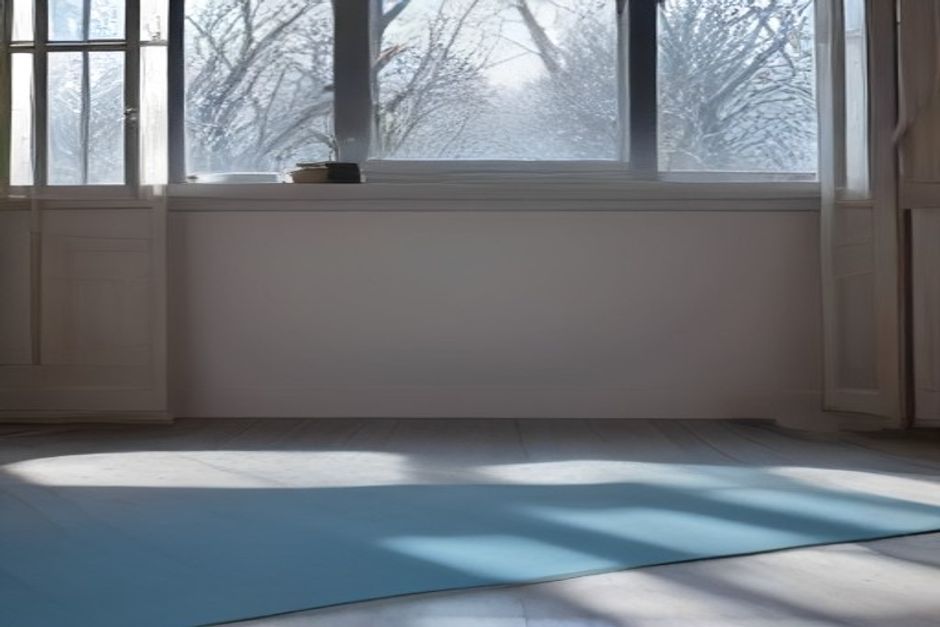
There's a morning every autumn — different every year, unmistakable every time — when you look out the window and the world has been edited overnight. The lawn is silver. The car roof crunches. Summer is no longer ending; it has ended. The first frost is a small annual event and a useful prompt: the body will need different things from practice now, and it will keep needing them for months. This is the practice for that morning, and the principles carry through until the thaw. For the broader seasonal arc, see our autumn practice notes and autumn grounding sequence.
What the cold actually changes
Not much, and everything. Cold muscles are stiffer muscles — not metaphorically, measurably. The tissues are less elastic at lower temperatures, the joints feel older than they did in July, and the body's first instinct on a cold morning is to contract: shoulders up, chin down, everything pulled inward like a house closing its shutters. This is intelligent. It's also a shape that, held all day, becomes the season's posture. A winter practice doesn't fight the contraction; it thaws it deliberately, then builds a little heat so the day starts from open rather than clenched.
Principle one: warm the hinges before the doors
In summer you can walk in cold and drop into sun salutations. In the frost months, the joints want a slow introduction. Start seated or standing, small and unglamorous:
- Ankles: lift each foot and draw slow circles, ten each way. Cold ankles are the first thing to complain in standing poses.
- Hips: hands on hips, big slow circles, five each direction, then a few gentle knee lifts.
- Spine: seated or standing cat-cow — the full floor version on our cat-cow page is ideal if you're on a mat — eight rounds, matching breath.
- Shoulders: roll them back ten times, then interlace the fingers behind the back and let the chest open for five breaths.
Three to four minutes, no heroics. The point is to arrive at the first real pose already warm, rather than using the first real pose to get warm. That's a summer habit that costs more each degree the temperature drops.
Principle two: slower transitions, longer holds
The frost practice trades flow for steeping. Where a summer sequence might move breath-to-breath, this one holds each shape for five to eight breaths and treats the transitions as poses in their own right — step the foot, pause, settle, then continue. A simple arc that works:
Child's pose with a long ramp — Balasana
How: Knees wide, forehead down, ten slow breaths before anything else happens. Let the back body widen on each inhale.
Why: It's the pose of the season's shape — curled inward — done deliberately, which changes everything. You're not hiding from the cold; you're visiting the shape on purpose and choosing when to leave it.
Slow sun salutations, halved speed
How: Three to five rounds at half your normal pace, pausing in each downward dog and each forward fold for an extra breath or two. Knees bent as much as the hamstrings request, which in November is more than they requested in August.
Why: This is where the heat gets built. Slow movement is harder than fast movement and warmer than fast movement — the muscles work through fuller ranges and generate the internal warmth the season isn't providing.
Standing poses as radiators
How: Warrior I or II, chair pose, goddess — held six to eight breaths each, with rests in between. Enough to make the legs genuinely work, not so much that form crumbles.
Why: The big muscles of the legs are the body's furnace. A few honest holds here and the room temperature stops mattering. The rest of the practice happens on a warmed engine.
A long, covered close
How: A seated fold, a twist on each side, then savasana under a blanket — non-negotiable in this season. Five minutes minimum.
Why: Cooling down fast on a cold morning undoes the practice's whole argument. The blanket isn't sentimentality; it's thermal management, and savasana under one is one of winter's few unambiguous gifts.
Principle three: practice with the cold, not against it
There's a temptation to treat winter as an obstacle to practice — the dark mornings, the cold floor, the reasonable duvet. The older view is that the season is the practice. The cold teaches what the body is actually like beneath the summer ease. The dark mornings make the lit room and the rolled-out mat a deliberate choice rather than a default. And the slowness the season demands is the slowness the rest of the year never quite permits. Our winter practice page goes deeper into the months ahead; the first frost is just the invitation.
The twenty-minute version
If time is short: three minutes of joint circles and cat-cow; five minutes of slow salutations; eight minutes of two standing poses and a lunge per side; four minutes of seated fold, twist, and a covered savasana. Done by the window, if you can manage it, with the frost still on the grass. The garden is doing its own practice out there — shutting down, conserving, holding steady. Yours is warmer, but the principle is the same.
The frost doesn't argue with the garden. It just arrives. A winter practice learns its manners from the frost.